
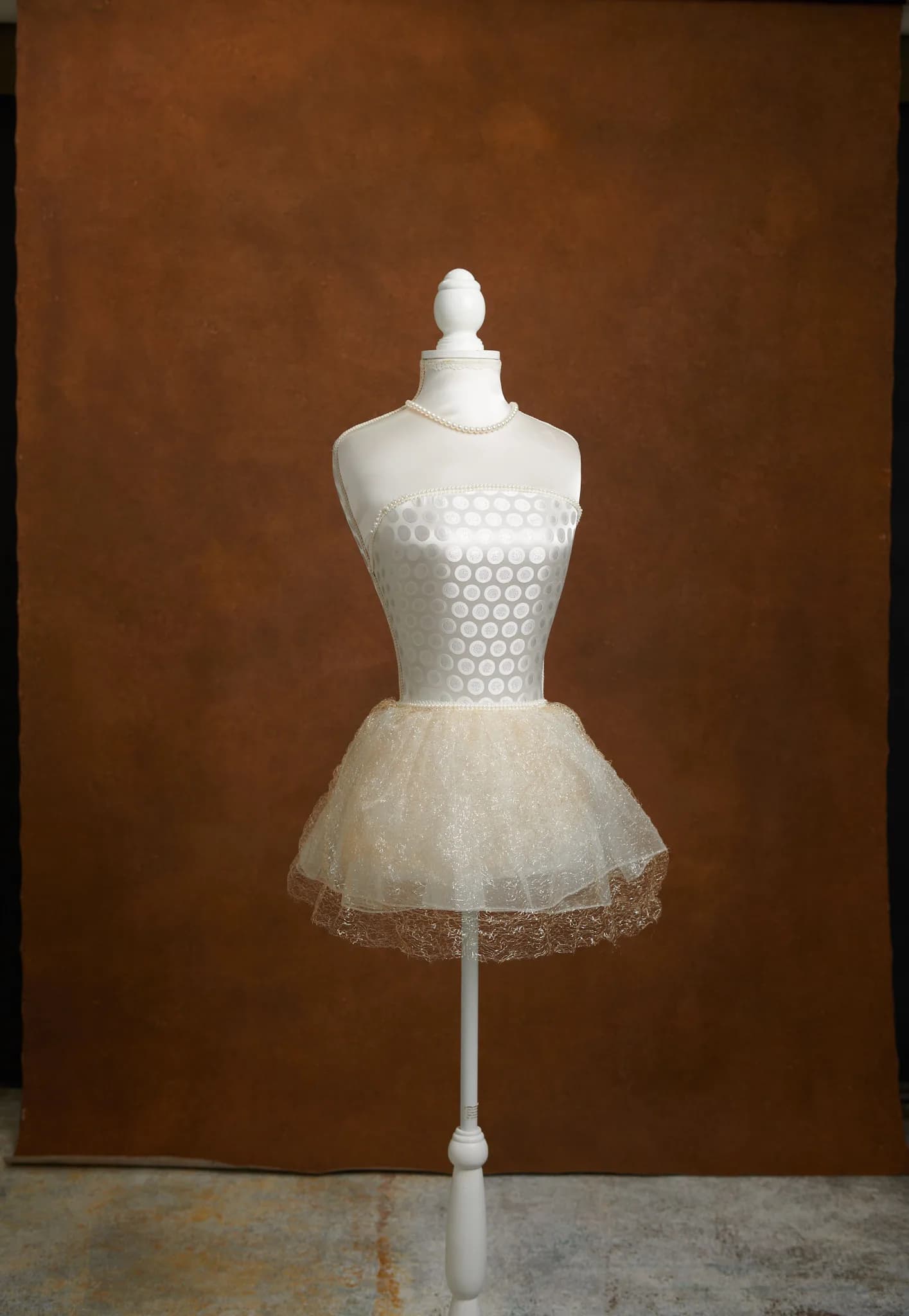
What is a canvas backdrop, and is it the same thing as the roll of paper in the corner of the studio? No. I paint these for a living and I still hear four different names for the same object.
Backdrop, background, drop, sweep. They all mean the surface behind the person you're photographing. Sweep usually means the paper kind that curves onto the floor so there's no corner in shot. None of it is technical, so ask me for a background and nobody here will be confused.
What a canvas backdrop is made of
Mine start as heavyweight cotton canvas, the same heavyweight canvas you'd stretch for an oil painting, only far wider. It gets primed first, so the paint stays where I put it instead of soaking through the weave. Then I paint by hand in thin layers, each one drying before the next goes on. That's what makes the tone move across the surface instead of sitting there as one flat colour. Stand three feet back and you'll see it shift, lighter through the middle, deeper toward an edge.
Once it's dry it goes onto a core, so it hangs straight and rolls up for the journey. Everything from 130 × 270 cm upward ships already mounted on an aluminium core, included rather than extra, and the 122 × 180 cm and smaller come on a wooden batten. Kept rolled and out of long direct sun it'll still be working in ten years. Fold it once and it won't be: a crease in dried paint stays a crease.
How it differs from paper, vinyl and muslin
Paper is cheap and perfectly clean. A 2.7 × 10 m roll is £89.99, and when the bottom gets scuffed you cut it off and pull more down. For product work, or anything wanting no texture at all, it's the right call. It also tears, creases, and doesn't survive a wet shoe. You're buying a consumable.
Vinyl is the wipe-clean answer to that. Spill something and it comes off with a cloth, which is why it turns up behind cake smashes and dogs. The trade is sheen: it's plastic, so it can throw a highlight back at a big soft light. Both sit on the paper and vinyl side of our shop, from a supplier rather than my studio.
Muslin is cotton too, dyed rather than painted, and it folds into a bag. That's the appeal, and a genuine one if you work out of a car. What it can't give you is texture: the weave is even the whole way across, so under a big soft light dyed muslin often reads as a single tone. I've compared muslin and canvas at length, and there's a guide to the materials too.
Sizes, and which one people actually buy
No law sets a standard size, but the work has settled on a few. The 100 × 135 cm at £170 is a headshot, or a small child. At 122 × 180 cm (£290) you've got a seated adult and comfortable half-length. Our best seller is 180 × 270 cm at £430, which holds a standing person with room to breathe. Most studio photographers land on 270 × 270 cm at £570, wide enough for two and tall enough to fall onto the floor. Above that sit 270 × 340 cm at £680 and 270 × 430 cm at £860, for full length and groups. Every cut is on sizes and prices, and the shelves split into small, large and XXL.
What a backdrop stand is for
A stand is two upright legs with a crossbar between them. The bar goes through a pocket or clips onto the top of the backdrop, the legs carry the weight, and you wind it up to whatever height the shot wants. Ours are on the backdrop stands page.
For a painted canvas there are two sensible ways to do it. The crossbar is one, and it's fine until the canvas gets heavy enough to bow the bar in the middle, which shows up as a sag across the top of your frame. The other is a pair of clamps, one at each top corner, gripping the core and holding it off two stands or two C-stands. Nothing spans the gap, so nothing sags. How to hold up a backdrop goes into both.
The colour question, especially for headshots
Headshots first, because that's where most backdrops end up. For headshots a mid grey or a warm neutral does most of the work, because it sits under nearly any skin tone and nearly any jacket without arguing with either. Go darker and you get drama, which suits actors and some corporate work, though you'll want the subject lit off the background or the two merge. The rule worth remembering: keep the background a step away from the outfit. Grey suit against grey canvas and the shoulders disappear. Grey is where most people start, with darker shades and lighter shades either side.
Every one of them is a one-off
Each canvas I paint is its own thing, and when it sells, it's gone. I can't reprint it, because there's no file to print from. What I can do is paint you a cousin rather than a twin: same palette, same feeling, a different canvas, and not identical, because my hand doesn't repeat itself. If you saw something already sold, or want a colour we've never made, a commission takes two to three weeks and costs what that size costs on the shelf. The rest is on the in-stock shelf.