
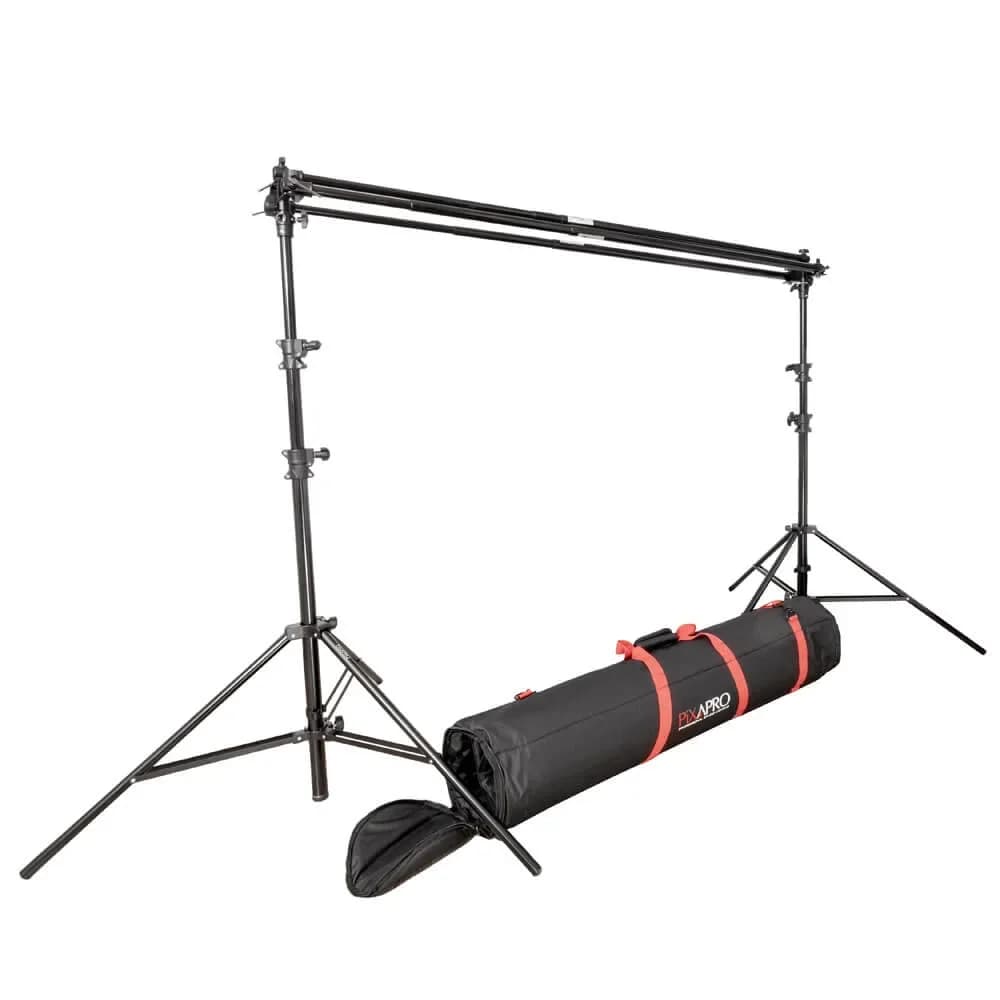
Every week someone emails us about a backdrop, and about once a month someone emails after buying one, asking why the middle of their crossbar has developed a gentle smile. The answer is nearly always the same: the backdrop and the stand were bought as separate decisions, and the stand lost.
Start with weight, because everything else follows from it. A muslin weighs less than a bag of sugar. A 2.72 m roll of seamless paper is around 4 to 6 kilos and awkward rather than heavy. A hand-painted canvas is a different animal: heavyweight cotton duck plus layers of paint, rolled on a core, and the big sizes arrive weighing as much as a loaded camera bag. A stand that shrugs off muslin will bow, wobble or slowly telescope downwards under a large canvas.
The light end: a basic telescopic kit
Most photographers start where I did, with two telescopic uprights and a bar between them. Our small adjustable stand is £74.99, packs into a car boot, and for muslin, small printed cloths and the odd paper roll it's honestly all you need. Add the telescopic crossbar at £33.99 if yours needs one. I'll say the quiet part about every stand in this class, ours included: stretch the crossbar to its full three metres, hang something heavy in the middle, and it will smile at you. Keep the span shorter than the maximum and heavy cloth close to the uprights, and it behaves fine.
The working end: heavy duty and triple frames
If backdrops go up and down in your studio every week, my advice is boring: buy once, buy heavy. The super heavy duty triple stand we stock costs £253.99, which stings next to the £75 kit until you notice it carries three backgrounds at the same time. Paper on one hook, vinyl on the second, canvas on the third, and you swap mid-session by pulling a different one down. I resisted this argument for years, then watched a photographer switch looks three times in one family session without the toddler ever getting bored. That sold me more than any spec sheet.
Autopoles, for people whose studio is also the spare room
An autopole is just a pole that braces itself between floor and ceiling like a shower rail with ambition. No legs. Nothing for a client, a dog or your own left foot to find in the dark. We started stocking autopole sets (from £269.99, up to 4 m ceilings) because photographers with small permanent spaces kept asking, and the triple hook version puts three rolls up one wall the way hire studios do it. Check your ceiling first though. They hold by pushing upwards, and a wobbly Victorian lath-and-plaster ceiling will lose that argument.
Two more answers worth knowing about. Shooting mostly headshots or products? A T-bone bracket on a single light stand carries a half-length roll for £79.99, gutter included to catch the curl, and takes thirty seconds to strike. And for our biggest canvases, 270 × 340 cm and up, the best rig isn't a background stand at all. Two C-stands gripping the core ends beat any telescopic crossbar for stiffness. That's how we hang them for our own product photos, so I'm not guessing.
Hanging the thing
This is the part the "how to" searches are actually asking about, so here's how each material goes up in practice. Paper is a window blind: the roll rides on the bar or the drive hooks and you pull down as much as the shot needs. Muslin gets draped over the bar, clamped, and then argued with. It arrives creased, it always arrives creased, and ten minutes with a steamer is part of the deal.
A painted canvas gives you more options than people expect, because it never travels loose. It ships rolled: small sizes arrive on a wooden pole, and the bigger canvases can come on an aluminium core — worth having, because cardboard tubes sag in the middle over time and aluminium doesn't. Many of ours are painted to work from either end too, so one canvas carries two looks depending on which way up you hang it.
From there, match the method to your room. Simplest: rest the pole or core in the hooks of a background stand and unroll only what the frame needs. Matthellini clamps grip the core and mount it to nearly any stand or bracket. If the pole is hollow you can run a metal extension bar through it and lock the ends with clamps, which also stops the roll creeping open mid-session. And for a permanent wall, autopole systems tension between floor and ceiling (or wall and wall) with expansion drive shafts and background hooks, keeping two or three rolls loaded with nothing standing on the floor.
Whichever way it hangs, one thing is never allowed: folding the canvas over the crossbar because the stand is a bit short for the drop. Dried paint remembers a fold forever. Keep the spare length rolled at the top like a scroll and the canvas will outlive the stand. I've repaired exactly one creased canvas in my career and I'd rather paint two new ones than do it again. Spring clamps at the top corners tame side-curl, and a lifting floor edge wants something soft laid on it, a rolled towel does fine, never gaffer tape.
Everything above lives on our stands and mounting shelf, shipped from UK stock. If you only keep one sentence from this article, keep this one: match the stand to the heaviest backdrop you own, not the lightest one, and you'll never meet the smiling crossbar at all.