
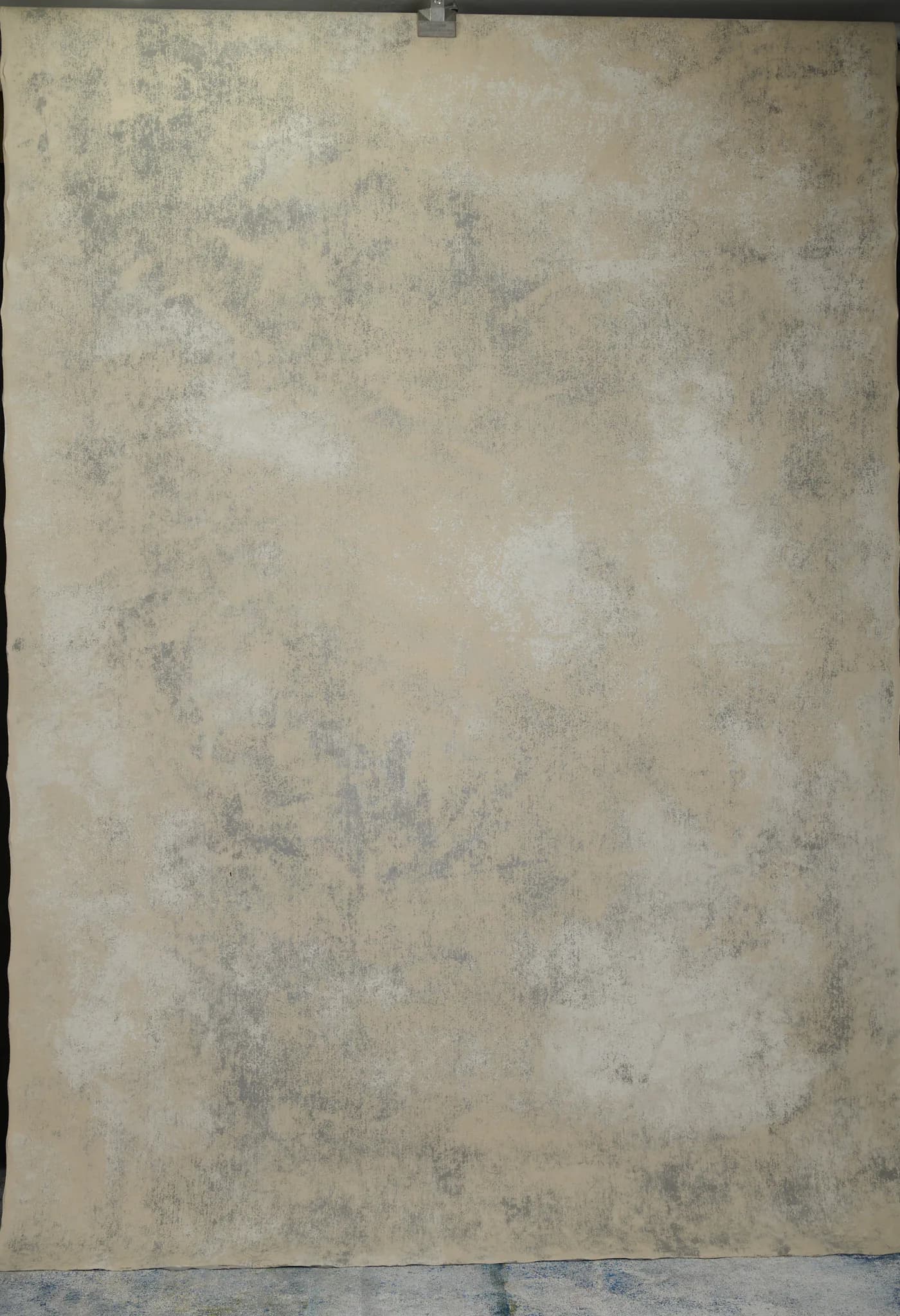
Most double-sided backdrops you'll find online are printed: one design on the front, a different one on the back, both made in a factory and identical to the next thousand. A painted canvas gets its second side another way, and I don't really get a say in how it turns out.
I paint on heavyweight cotton canvas here in the UK. While a canvas dries, some of the paint works its way through the cotton. When I turn it over, the back is the raw cream ground with the front colour bled into it in patches, drifts and speckles. It looks a bit like old plaster, or a fresco that's been rubbed back. I can't plan that pattern and I couldn't repeat it if you paid me double.
Two backdrops that don't look related
Take a deep sage I finished recently. The front is a dark teal-green, fairly even, the sort of colour people buy for moody portraits. The back is cream with teal-green patches wandering across it. You'd never guess it was the same piece of cloth. A light warm grey with a pinkish tint went the other way: the back came out warm cream with grey drifting through it, softer and a lot more textured than the front. On a deep red I painted at 100 × 135 cm, the red marks gathered strongest around the edges of the back and left the middle pale.
That's the useful bit. You're not getting the same backdrop in a lighter shade. You're getting one quiet, fairly flat colour and one busy, broken, much paler surface, and they solve different problems.
Not every canvas earns a second side. Sometimes the soak-through is thin, or it's lumpy in a way I wouldn't want behind a face. The ones I sell as double sided say so in the listing, and I photograph the back too, so you see the actual pattern you're buying rather than a description of it.
Which side for which job
I'd treat the front as your low-key option. Dark greens, deep reds, the stronger greys, they tend to sit back behind a subject and let skin and clothing do the talking. If you shoot moody portraits or anything that wants a dark, close feel, that's probably the side you'll hang most weeks.
The back suits lighter work. Airy family sessions, fine-art portraits, maternity, anything where you'd normally reach for something pale with a bit of age in it. Because it's mostly cream, my guess is it'll shift with a warm or cool light more readily than the front does. I'd test that with your own lights before a paid session, though. Every room behaves differently.
Distance changes both sides, and it's worth knowing before you decide you don't like one. Pull your subject well away from the canvas and keep the light off it, and the back's patches tend to soften into a gentle, uneven tone. Push the subject closer, or let some light spill across the surface, and the marks get louder. The front does the opposite thing to a lesser degree; its drift between lighter and darker areas shows more when light skims it from the side. Neither rule is fixed. Shoot a few frames of each side empty before the client arrives and you'll know.
Turning it round
Our canvases travel rolled on a core, either a wooden batten for 122 × 180 cm and smaller or an aluminium core from 130 × 270 cm up. You hang it the same way whichever side faces you. Rest the core in the hooks of a stand, or grip the ends with clamps, and unroll as much as the frame needs. To swap sides, take it down and roll it back up the other way round, so the other face comes off the roll towards the camera. It takes a couple of minutes. It isn't something you'll do between frames.
Don't fold it over a crossbar to show the back, however tempting it is. A fold in dried paint leaves a crease that's hard to get out. I've written more about that in the care guide.
Is the second side worth paying for?
Our sizes start at £170 for 100 × 135 cm, then £290 for 122 × 180 cm and £430 for 180 × 270 cm, and the price doesn't change because a canvas happens to have a good back. So the second side isn't an upgrade you pay for. It's just there when it's there.
If you're weighing up a painted piece against a printed reversible one, I've put down what I'd look at in how to judge a hand-painted backdrop. And if green is where you're heading anyway, have a look through the green backdrops, because green tends to leave a mossy, patchy back on the cream. Everything else that's finished and ready to post is on the in-stock page.