
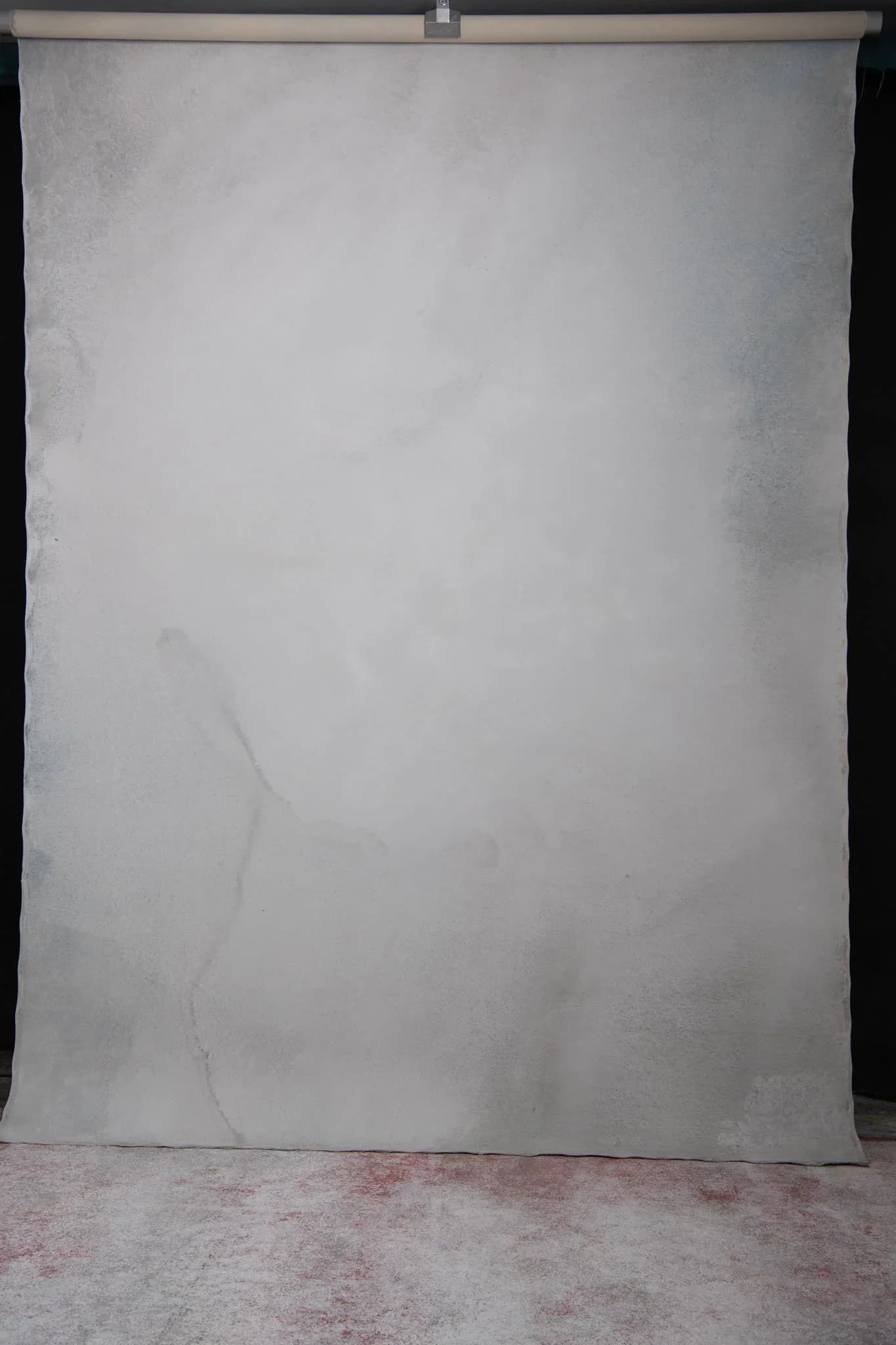
A backdrop I've made is dried paint on cotton canvas. That one fact covers most of what follows. It's tougher than people expect, and it won't forgive a sharp bend.
So the care is mostly about not creasing it, and about being slower than you'd be with a muslin you can throw in the machine.
Can you wash a hand-painted backdrop?
No. Never wash it and never soak it, and keep it away from the machine entirely. If what's on it is dry, dust off the studio floor, a bit of chalk, then start with a dry cloth and see how far that gets you. Usually that's far enough.
For a mark that won't lift dry, a damp cloth works, used very carefully. Barely wet, light pressure, a small area at a time, then leave it to dry on its own. What I'd warn you against is the instinct to go harder when the first pass does nothing. Water and pressure together on dried paint can turn a mark into a patch, and a patch is a lot more visible on camera than the thing you were trying to remove.
Roll it, never fold it
A fold leaves creases, and they're hard to get out. I'd rather be blunt about it than have someone find out with a canvas they've just paid for. Rolled is the only way one of these should ever be stored, and it usually rolls with the painted side inside, which is how yours will have arrived.
It arrives rolled on a core, inside a tube. Everything from 130 × 270cm upward comes on an aluminium core, included in the price, and 122 × 180cm and smaller come on a wooden batten. Keep whichever one you got. The core isn't packaging. It's what the canvas is rolled on and what you hang it from. Sizes and what they cost are all on the sizes and prices page.
Can you iron photography backdrops?
Don't. I know that's not the answer people want. A crease in dried paint is a crease, and an iron isn't going to talk it back out of the cotton. Heat on paint is a risk I wouldn't take with a piece that can't be remade identically. The better answer is that the question mostly shouldn't come up: if it arrived rolled and stayed rolled, there's nothing there to iron.
A canvas that hangs for a day or two tends to relax anyway. If there's a slight wave near the top after you unroll it, hang it, walk away, and look again tomorrow before you decide it's a problem.
Where to keep it between shoots
A dry room. That's the whole requirement, and damp is the thing I'd actually worry about, not light.
Direct sun isn't a problem unless the canvas is permanently exposed to it. An afternoon with window light falling across it while you work is nothing at all. Leaving it for two years somewhere the sun crosses the same strip every day is a different question, and that one I'd avoid.
Moving it about
I see everything. Some people put it straight in the car boot and call it a day, and those tend to be the people who aren't bothered by the odd scratch or wrinkle. That's a fair position. A backdrop is a working tool and it's allowed to look like one.
If you're sensitive to that sort of thing, though, the answer is simple enough: keep the tube it came in, and put it back in the tube every time it travels. It's the difference between a canvas that stays as it left me and one that picks up its own history in the back of a car.
Everything I paint is a one-off, so a piece you've looked after isn't replaceable with an identical twin, which is the real argument for the tube rather than any of the fussier advice you'll read. What's finished and ready is on the in-stock page, and if you want something painted to your own colours there's the commission page.