
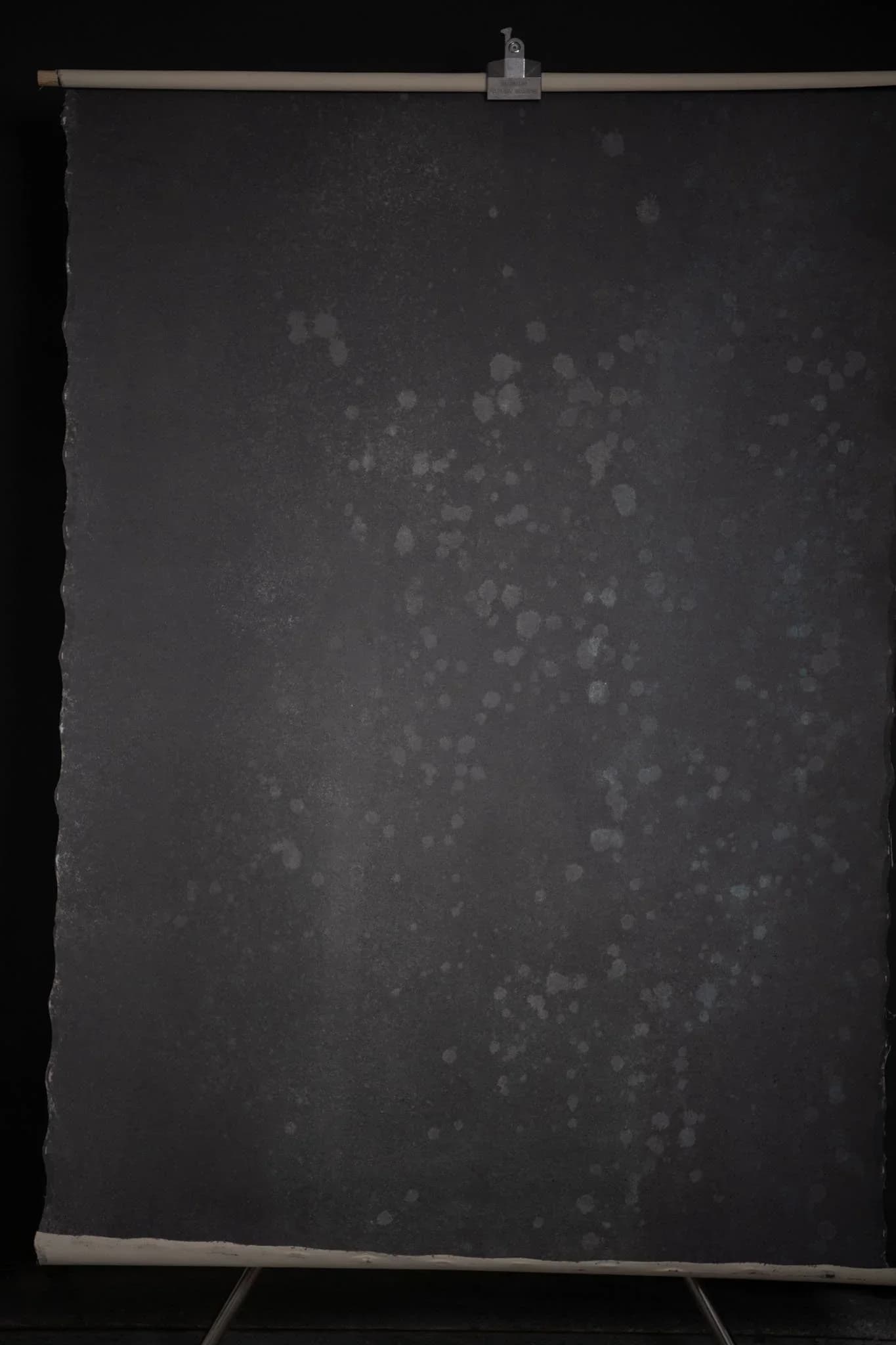
Search for the best hand-painted backdrops and what you get back is a list of shops. That isn't much use, because you're buying one object that one person made, and two canvases out of the same workshop can be quite different. So here's how I'd judge one. I paint them for a living, so discount my opinion accordingly.
None of it needs a trained eye. It's mostly reading the listing photos properly and asking two or three awkward questions before the money moves.
Start with the cloth
Ask what it's painted on, and expect a material in plain words rather than "premium fabric". A painted backdrop wants cotton canvas, heavy enough to hang straight and to take paint without the weave vanishing under it. A fair amount of what's sold as canvas is polyester printed to look like canvas, and the weight gives it away: a poly sheet folds into a jiffy bag, cotton canvas never does. Ours is cotton, painted in our own studio.
How can you tell a hand-painted backdrop from a printed one?
Painted texture changes with the light and the angle you shoot from. A print looks the same from everywhere. That's the test, and you can run most of it from the sofa. Light coming across a painted surface finds the bits that sit proud and the bits that sank into the weave, so the same canvas reads soft under a big frontal light and much rougher once the light swings round to the side. A printed texture is a photograph of a texture, lying flat. Do what you like with your lights; it stays the picture it was the day it came off the printer. Neither is wrong, mind. Printed backdrops are cheap, light, repeatable and exactly right for a themed newborn set. Just know which of the two you've paid for.
Look for the drift
A painted piece is never one colour. Run your eye across the surface in the listing photos and the tone should move: often lighter through the middle, deeper as it goes out toward the edges, with softer patches in between. That drift isn't sloppy work. It's the reason anybody pays for paint instead of paper. It hands the eye something to rest on behind your subject without handing it anything to read. A canvas that photographs as one even tone all the way across is a colour, not a background.
Scale matters too. Ours goes on in broad passes over the whole cloth, so the lighter and darker zones are big ones you notice from across the room. Fine, even, regular grain is usually a print pretending.
One is genuinely all there is
A hand-painted canvas is a one-off. There's no reprint and no second copy, and when it's sold it's gone. The next one I paint in those colours will be its cousin, not its twin. Two things follow. Every piece on our in-stock shelves is photographed as itself, never as a sample standing in for a range, so the canvas in the photos is the canvas that turns up at your door. And if you've been thinking about one for three weeks, it may well not be there in week four. That's just how one-offs behave. If the colour you wanted has gone, a commission takes one to six weeks.
Turn it over
Ask about the back. Paint soaks through cotton, and on some of ours the soak-through has quietly become a second backdrop: paler, softer, mottled in a way I couldn't reproduce on purpose. Those go out as double sided and the listing says so. Worth asking any maker, because two usable faces changes the arithmetic on what you're spending.
How it travels, and what the size really is
Canvas gets rolled, never folded. Ours ships on a core inside a tube. A fold in dried paint can leave a crease that's hard to get out, so anything arriving folded has told you something.
Then sizes. Ask for real centimetres, both numbers, and hold them against the wall you've actually got rather than the studio you're planning. Our ladder starts at 100 × 135 cm for £170 and runs up to 270 × 420 cm at £860, and every rung sits on the sizes and prices page with its own figure beside it. A price that won't say which size it belongs to is one that surprises you later.
Four questions worth asking anyone
- What is it painted on? You want a material named, in words you recognise.
- How was the texture made: painted onto the cloth, or printed onto it?
- Can I see the actual piece I'm buying, rather than a photo of one like it?
- And if the colour isn't what I hoped once it's out of the tube, then what?
Nobody sensible minds being asked. I'd rather answer all four before the money moves than one of them after. A maker who'll dodge the first two has answered you anyway.
Last thing, on colour. Screens lie, mine included, and a deep green under a gridded light looks nothing like the same green on your phone at eleven at night. Stuck between two? Ask for a photo of the canvas hanging in daylight. I'll send one.