
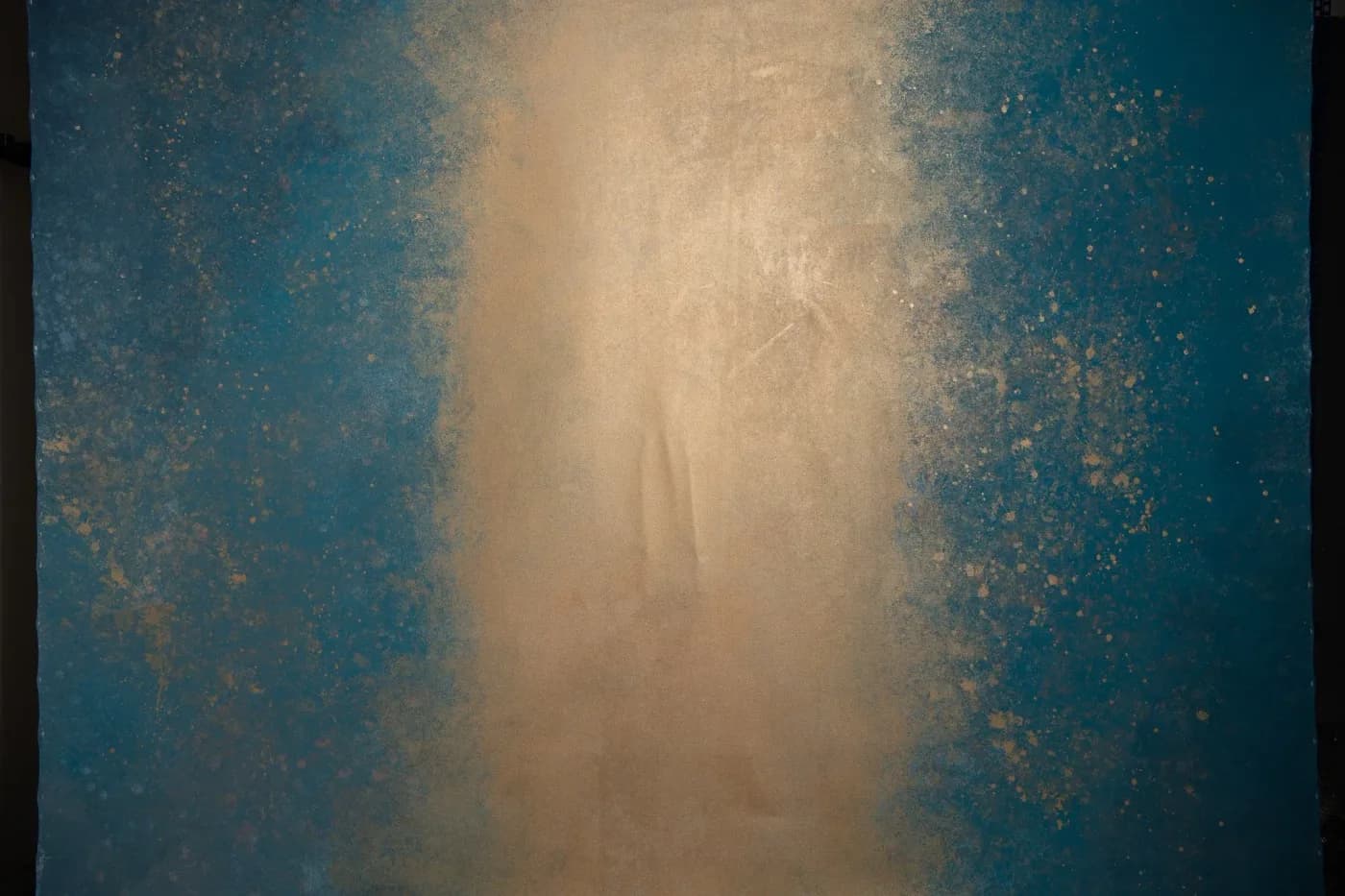
This question lands in our inbox a few times a month, usually worded exactly like that. Someone sees a portrait shot against one of those mottled, softly glowing canvases, asks where the background came from, and gets told "it's an Oliphant". Then they look up the price, and the shipping from New York, and start googling alternatives.
The short answer: Oliphant Studio is a backdrop painting workshop in New York, run by Sarah Oliphant, and their canvases became the signature look of American editorial portraiture. The longer answer is more interesting, because the style is over a century older than the name.
Painted backdrops are a Victorian invention
Walk into almost any British portrait studio in the 1870s and you'd find painted scenery. Balustrades, drawing rooms, misty gardens, the odd alarming seascape. Scenic painters made a living travelling between studios repainting them. The customer stood in front of a fiction and everybody understood the arrangement.
Then the trade nearly died. Once seamless paper arrived in the middle of the twentieth century there wasn't much argument left: paper was cheap, clean and identical every time, and a painted canvas was none of those things. By the 1970s hand-painted backdrops had almost disappeared from working studios.
What Oliphant actually revived
Sarah Oliphant started painting backdrops in New York in 1978, first for theatre, then for photographers. Over the following decades her canvases ended up behind a remarkable share of American magazine portraiture. The modern look people mean when they say "Oliphant-style" is her revival: no scenery, no illusion, just a big field of layered colour with real depth in it. She didn't invent painted backdrops, and to her credit she has never claimed to. What she did was prove the old craft belonged in modern portraiture, and the industry followed.
What makes the look
Stand close to one of these canvases and the surface is quietly busy. The painter builds thin, broken layers of closely related tones over each other (scumbling, if you want the trade word), so the colour shifts as you move across the cloth. Most of them carry a subtle glow near the middle that falls away toward the edges, which pulls the eye to the subject the way a lens vignette does, except it photographs as natural because it is actually there. And the finish is dead flat. Any sheen throws small highlights on camera and the canvas starts reading as plastic.
That's the whole recipe, and none of it is secret. What costs money is the labour: each layer has to dry before the next goes on, and the painter has to keep the whole nine-foot field coherent while working at arm's length from it.
Getting the look in the UK
An Oliphant canvas runs roughly $1,000 to $1,700 depending on size, before you add transatlantic freight and import VAT. If the budget covers it and you want the original name hanging in your studio, buy the original. Nobody regrets one. They are the benchmark for a reason.
If the budget doesn't stretch that far, the craft exists here too. We paint the same way, in layers on heavyweight cotton duck, in our UK studio. Our sizes run from 100 × 135 cm at £170 up to a 270 × 430 cm wall of colour at £860, with the popular 270 × 270 cm at £570, and everything on the in-stock shelves ships rolled on a core within days rather than months. For a sense of the range: Gilded Sapphire is a teal canvas with a warm gold centre glow, Dark Grey Charcoal is the moody editorial staple, and Autumn Palette does the warm brown thing with blue and rust drifting through it.
The Victorians would find the whole conversation funny. A hundred and fifty years on, we've come back around to standing people in front of paint.