
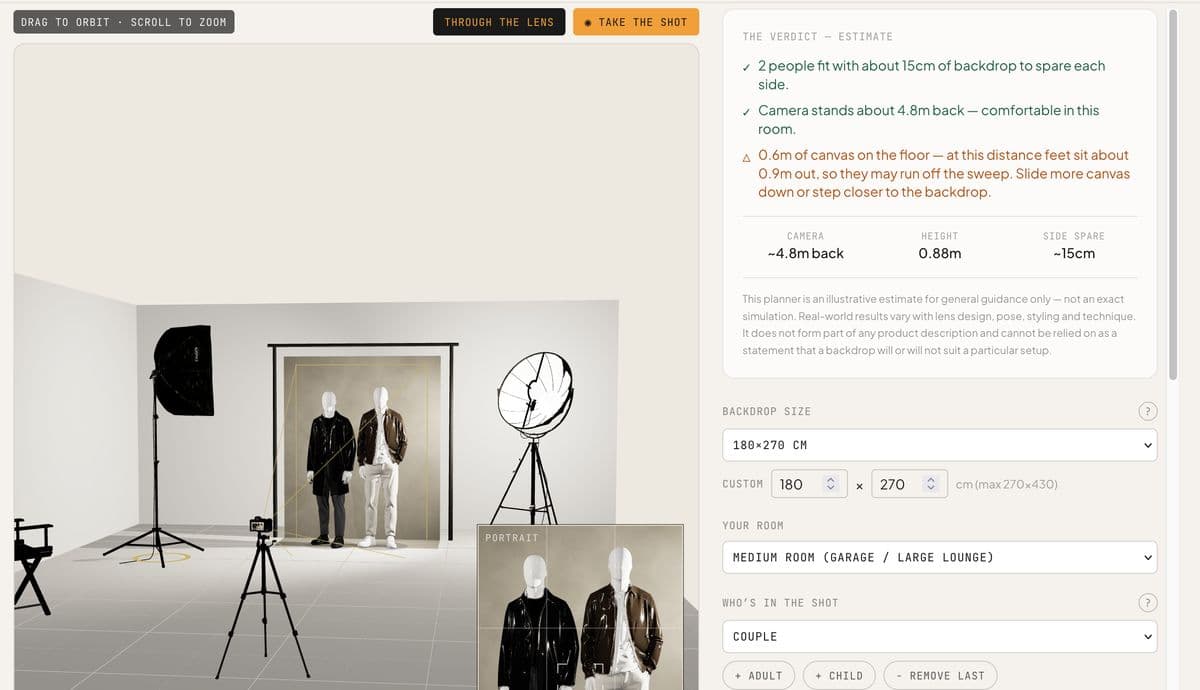
Which size do I need? We get that email more than any other, and honestly it deserves better than a shrug and a size chart. A backdrop is a real object, and your room has a ceiling that doesn't care what you ordered.
So we built a planner into the site. Free, no sign-up. Give it your ceiling height, the space you can clear, who's in the shot and the lens you like, and it builds the room to scale with the backdrop hanging in it. The presets are honest about where photographers actually work — garage and large lounge included.
Three numbers decide your shot
Take the couple shoot most people plan first. Garage preset, two adults, the 180×270 hung. The planner shows canvas to spare each side, camera about three metres back, everyone's happy. Add a third adult and the verdict stops being polite. They don't fit, it says, and here's why.
Ceiling turns out to be the least scary number. A 270cm canvas under a 240cm ceiling just means the spare length stays rolled, or spills forward to start a sweep. Depth's the killer. Your lens decides how far back you stand, and sometimes the planner has to break it to you that the spot is in the hallway. It watches feet too, and warns when they'd land off the edge of the sweep.
What the screen actually shows you
The main view is the room in 3D. Mannequins stand where your subjects would, and you drag them around the canvas to change the spacing. A camera sits on its tripod at the calculated distance, and there's a through-the-lens view when you want the framing rather than the floor plan. Press take the shot and you get a portrait preview of what that lens, at that distance, on that backdrop, would actually give you.
The controls go further than the presets. Focal length runs from 24mm to 200mm on a slider. You can shoot full frame or turn the camera portrait. If the automatic camera distance annoys you, switch to manual and put it where you'd stand. Sizes aren't locked to the shop's standard cuts either. Type in anything up to 270×430 and it'll hang that instead.
Under the verdict sits a small honest paragraph saying the planner is an illustrative estimate, and that real results vary with lens design, pose, styling and technique. We mean it. It's a planning tool, not a contract. It'll also suggest backdrops that suit the plan from what's genuinely in stock, which is the only place the shop intrudes on the maths.
If you'd rather just ask a human
Some people would rather have a rule of thumb than a simulator. Fine, here's ours. Most people end up with the 270×270, a grey covers the most situations, and when you're torn between two sizes, take the bigger one; the sizes and prices page shows what each jump costs. Nobody's ever written in wishing their backdrop were smaller.
Either way, the size argument is better settled before the tube ships than after. The planner takes about two minutes, and most of them go on dragging the little figures around the room, which we admit is half the fun.